The AISOFT agentic engineering programme
From vibe coding toagentic engineering.
A structured programme for working engineers, run by the team that ships agentic systems into production for a living. You'll finish having built and shipped something real: briefed properly, checked against a standard, and defensible in review.
Who it's for
Engineers who already ship.
You read stack traces without flinching and you know a bad diff when you see one. No machine-learning background is required. Nothing in the programme asks you to train a model. What it does ask for is a project you genuinely want to exist, because from Part 3 onward every exercise runs against it.
It is not an introduction to programming, and it is not a collection of prompt tricks. The discipline it teaches only makes sense to someone who has already paid the price of working without it.
The role this prepares you for.
Forward Deployed Engineer: embedded in a customer's team, shipping agentic systems into their stack, and handing over cleanly enough that they run it without you.
It is the fastest-growing engineering role in the industry and the hardest to hire for, because almost nobody trains for it directly. This programme does.
Who's behind it
Who teaches it.
The team has built data platforms, data science labs and GenAI labs, and turned them into production services that scaled: used by top banking, mortgage and retail clients. Before that, application performance monitoring at Dynatrace, including anomaly detection running against live sites.
The material comes from that work. What the course says about cost, about security review, and about handing a system to the people who will run it is what those engagements taught.
The first cohort is under way.
A group of working engineers is going through the programme now, and it is being refined as they go.
The curriculum
Seven parts, taken in order.
Each part assumes the one before it. The early parts get you working confidently with an agent; the later parts are what separates an engineer who can demo from one a customer will pay.
| Part | What it covers | Lessons |
|---|---|---|
| 1 · Foundations | Models, agents, harnesses and multimodality: the conceptual stack, so the practical lessons land rather than wash over you. | 5 |
| 2 · Get set up | From nothing installed to a working agent session on a codebase you know, and staying in command of it. | 4 |
| 3 · Build something real | Choose your project. Plan it, build it in reviewable slices, ship it. | 4 |
| 4 · The core concepts | Briefs, evaluations, working context, quality standards and design discipline: the practices that hold up once real users arrive. | 9 |
| 5 · Scale up | From a single agent to a way of working: orchestration, review gates, and where to take it next. | 3 |
| 6 · Operating in the real world | The widest part of the programme. Tooling trade-offs, team structure, discovery and scoping, communicating with non-engineers, observability and cost control, security, and the handover. | 18 |
| 7 · Building on the platforms | Beneath the CLI to the API itself: tool use, streaming, agent SDKs and MCP. | 4 |
Outcomes
You finish with work you can show.
Not a certificate of attendance. A project you took from nothing to shipped, and a way of working you can apply on Monday to whatever is already on your plate.
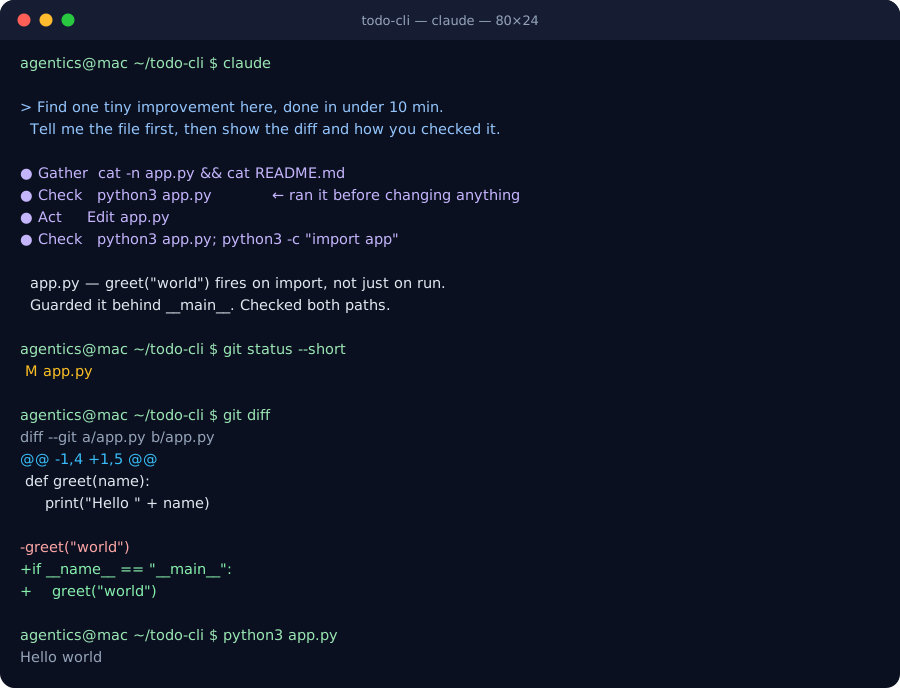
Every example in the programme comes from production practice: real sessions, real commands, real failures and what they cost.
- A brief an agent can build toSo the work that comes back is the work you asked for.
- A definition of done you can checkShipped becomes a test result, not a feeling.
- A quality standard that holdsCatch the code that looks right and isn't, before review.
- A handover a customer can runThe difference between a contractor and an engineer they call back.
Bringing a team?
There is an on-site version: three days with fifteen to twenty-five of your engineers, working in small groups against your own repositories and deployment path. Build on the first day, evaluate on the second, deploy and hand off on the third.
A one-day briefing is available for leadership, covering the decision rather than the build. Both are quoted per engagement.
Come and build something.
Tell us what you're working on and we'll open your access, usually the same day. Free of charge while the programme is in its opening cohorts.